Why 90% of Real Estate Leads Never Get a Callback
Every real estate business we talk to says the same thing: we're not getting enough leads. After working with multiple real estate clients, we've come to think that's rarely the real problem. Teams are generating leads fine — through ads, cold calling, referrals, portal listings. What breaks is what happens in the minutes right after.
Real estate buyers roughly split into two kinds: people actively searching right now, and people who might start looking if someone reaches out at the right moment. This is about the first kind, because that's where speed decides everything.
When I was house-hunting, I was submitting leads on Housing.com and MagicBricks, reaching out to brokers directly too. Some got back to me after two days. Some after three. But I ended up visiting the site of whichever broker called me back first, in real time, while I was still actually thinking about it. That's really the whole pattern: respond in 60 seconds to 2 minutes and you catch someone while they're still hot. Wait an hour or two and they've either gotten busy, or five other brokers chasing the same portal lead have already gotten to them first. Realistically, nobody visits four or five properties in a day — you're doing one, maybe two. If someone else gets there before you, that opportunity is gone, not delayed.
Real estate teams describe this as a lead "going cold." Usually it hasn't gone cold — it got reached too late, and by the time someone calls, the buyer's already moved on or been overwhelmed by other brokers chasing the same lead.
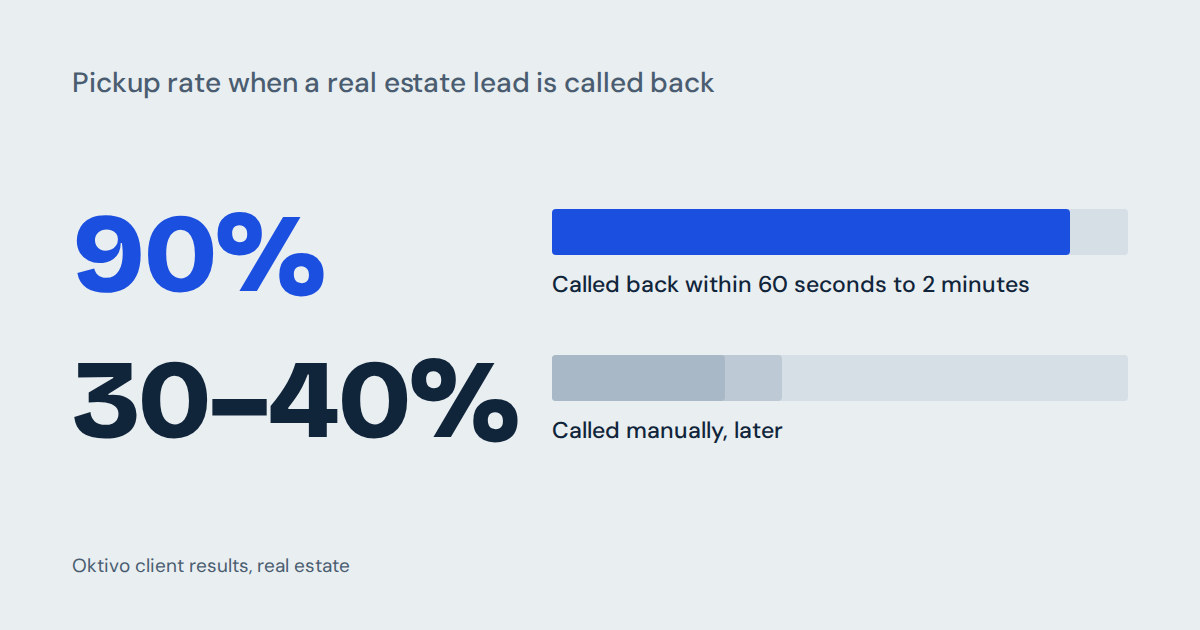
This is where AI voice agents actually help, and it's worth being precise about why: not by generating more leads, but by closing the gap between capture and first contact. Calling back within 60 seconds to 2 minutes, while the buyer's still actively thinking about it, is what moves the pickup rate. Across the clients we've worked with, this got pickup rates to around 90%, against 30-40% when the same leads were called manually and later.
There's more to this — how follow-up consistency plays into the same problem, what buyers and clients tell us they push back on, and what the actual cost-per-outcome numbers look like once this is fixed. We'll get into each of those separately. For now, the core point stands: if leads are going cold, look at response time before you look at lead volume.